The board is only as good as the last person who updated it.
An emergency department already has a tracking board. The problem is that keeping it true is somebody's job, and that somebody is usually the person you least want standing at a keyboard. Ours is fed by the workflow instead.
Three things you have probably said out loud
The board goes stale by mid shift
It is accurate at seven, drifting by eleven, and fiction by three, because updating it competes with patient care.
Rooms turn over faster than paper
A department that turns a room every two hours cannot keep a taped sign correct at the door.
Nobody can find who is where
Charge, attending and transport each keep their own version, and none of them agree.
Fed by the workflow. Not by a keyboard.
The events already exist
Registration, orders, results, bed assignment and discharge are already messages. The board reads them, so nobody types a status.
Presence does the rest
When a badge crosses a doorway the board knows the room has been seen, and the call clears without anyone pressing cancel.
The door keeps up
Door signs change with the chart, which in an emergency department means they change constantly and correctly.
The board an emergency department actually needs
| Column | Where it comes from | Why it matters here |
|---|---|---|
| Room and patient | Registration and bed assignment | The single most argued about fact in the department |
| Waiting on | Orders, laboratory and imaging | Makes the holdup visible before somebody asks about it |
| Time in room | Presence and arrival | Length of stay stops being a report you read next month |
| Precautions | The chart | Posted at the door the moment it is documented |
| Disposition | Orders and bed requests | Admitting and transport see it at the same time you do |
The one the patient is looking at while they wait.
A tracking board tells the department what is happening. It tells the person lying in the bay nothing. That is a second board, in the room, facing the bed — and almost nothing on the market is built for it.
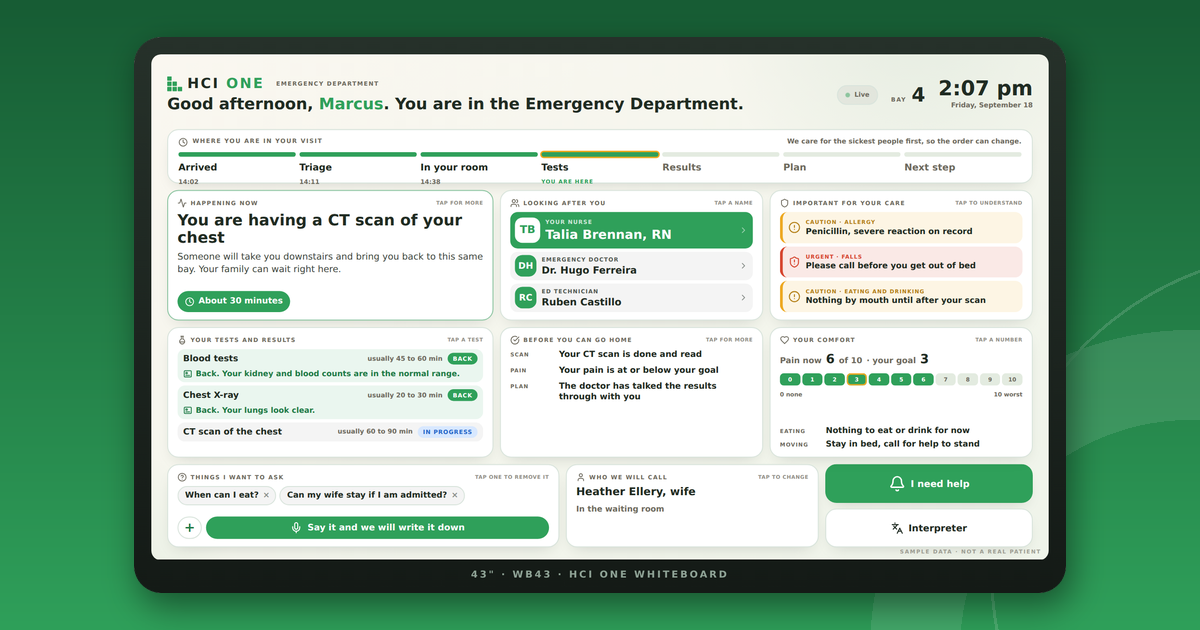
Where they are in their visit. Who is looking after them, by name. What each test is and roughly how long it takes. What has to be true before they can go home. The questions they thought of at 2 AM, typed or spoken onto the board so they are still there when the doctor finally walks in. And a help button that raises a real nurse call, not a message inside an app.
We read the market before we drew a screen.
15 companies
Every in-room patient technology product we could document, catalogued element by element, from product documentation rather than marketing summaries.
1 of 15
Exactly one sells an emergency department product. The category is built for inpatient units, where a patient stays for days and the board describes a plan.
2 studies
That is the entire published evidence base for in-room boards in an emergency department. The one controlled trial is a four-room pilot, and we call it a four-room pilot.
| Element | How common | Why it is on our board |
|---|---|---|
| Who we will call | 0 of 15 | Rated the most useful item on the board by every group of respondents in the published survey work |
| Discharge criteria, not a date | 0 of 15 | A date is a promise that breaks. Criteria stay true all day |
| Shift change time | 0 of 15 | Free to show, and it explains why the name on the board is about to change |
| Interpreter, from the board itself | 0 of 15 | Federal language access rules, in the department where they bite hardest |
| Typical turnaround for a test | 1 of 15 | Answers how long without promising anything about one patient's result |
| Touch on the board itself | 3 of 15 | In a treatment room, the wall is what is within reach |
Three rules came out of the research.
Identity may be shown. The clinical reason may not.
A patient's name on their own board is defensible. A chief complaint on any surface a visitor can read is not. That one sentence settles most content questions before they start.
Set expectations, never make promises.
Ranges, next steps and criteria. Not countdowns and dates. Every board that has disappointed a patient did it by being specific about something it could not control.
If it does not keep itself current, it does not go on.
A field that depends on somebody remembering to update it will be wrong within a shift, and a board that is wrong is worse than no board at all.
What we left off is written down too: diagnosis, an acuity number, any countdown to being seen, result values in the open, code status, and anything at all about another patient. Ask us for that list. The reasoning matters more than the list.
Bring us your current board.
Photograph it, whiteboard or screen. We will rebuild it from your event feeds with sample data and you can tell us what is missing.