A Camera Is Not an eSitter
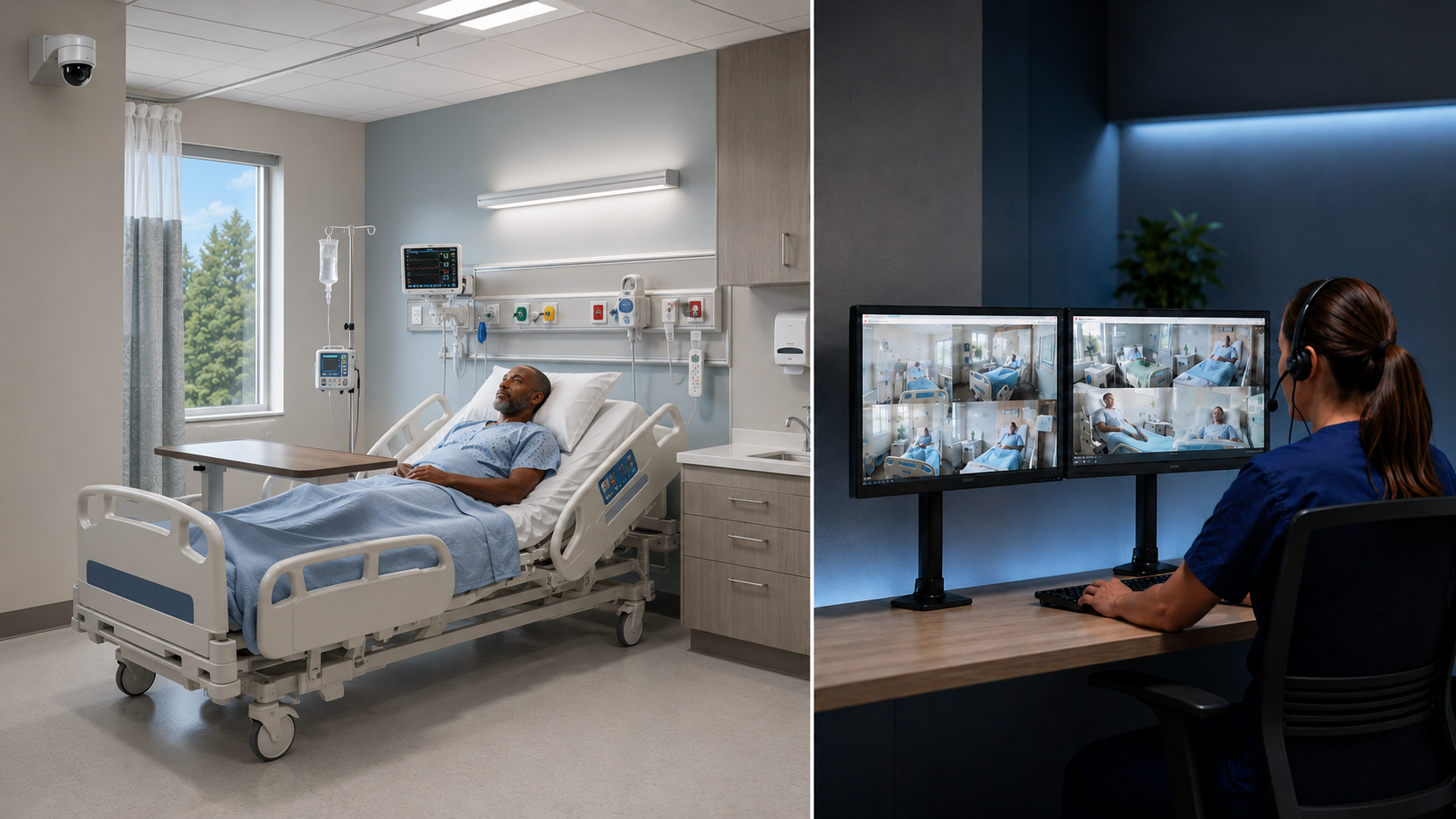
Putting a camera in a patient room does not create an eSitting program.
It creates a patient room with a camera.
Mounting the camera is the easy part.
Connect it to the network.
Aim it at the bed.
Display twelve or sixteen video feeds on a large monitor.
Take a picture for the presentation.
Everyone looks impressed.
Then someone asks the important question:
What happens when the patient tries to get out of bed?
Observation is only the beginning
A real eSitting program needs more than video.
The observer must see the patient clearly, communicate with the patient, understand the room context, alert the bedside team, and escalate the event quickly.
The camera matters.
So do the microphone, speaker, network, patient assignment, room information, staff communication, alert process, documentation, and people operating the system.
If those pieces do not work together, the hospital does not have virtual observation.
It has a very expensive livestream.
HCI ONE Guardian is going live with Hanwha
We are preparing to bring HCI ONE Guardian eSitting live using Hanwha cameras.
Hanwha makes excellent commercial cameras. Guardian provides the virtual care workflow surrounding them.
An observer can monitor multiple patients, communicate directly into the room, and involve the bedside team when help is needed.
The goal is not simply to see a patient moving toward the edge of the bed.
The goal is to get the right person to the room before gravity gets involved.
That requires the virtual team and bedside team to operate as one care team.
The economics matter
An off the shelf Hanwha camera costs approximately $1,000.
Many proprietary virtual nursing systems can cost five to ten times more per room, every year.
They may also arrive with a collection of dedicated computers, sensors, cables, power supplies, adapters, and other hardware that turns the patient room into a rat’s nest with a very impressive invoice attached.
Hospitals can make that work in an intensive care unit or a small pilot.
Expanding it across hundreds of rooms is a different conversation.
Our goal is to build virtual care that can be installed everywhere.
Medical units.
Surgical units.
Emergency departments.
Rehabilitation rooms.
Observation rooms.
Not only intensive care units. Not only ten showcase rooms selected for a pilot. Not only the rooms close enough to the nursing station that someone can reboot the equipment.
Everywhere.
That requires a system that is affordable, manageable, and simple enough to scale.
Good hardware should remain useful
Our open architecture lets hospitals use proven cameras from companies such as Hanwha instead of buying another proprietary device simply because the software vendor requires it.
If the hospital already owns the right camera, we want to use it.
If it needs new cameras, it should have options.
That may not sound revolutionary.
Good.
Hospitals have purchased enough revolutionary hardware that became obsolete three years later.
The intelligence should live in the platform, not inside a box the hospital can never replace.
This is round two
Many of our customers already use HCI endpoints for patient communication and virtual nursing.
Now we are returning to add eSitting.
Soon, the same platform will support medical grade transcription, virtual bedrails, and additional safety workflows.
We are not filling the room with more disconnected equipment.
We are making the equipment already there work together.
A camera lets someone see the patient.
A real eSitting platform connects that patient to someone who can help.
One is video.
The other is care.
And one of them should not require a second mortgage for every patient room.
Part of the team building the operating system for the patient room.
We Built a Hospital Room in a Warehouse
Field notes
A Help Button Has to Reach Someone
Nurse call
Zero of Fifteen
An emergency department team stopped one of our demos a few weeks ago, two minutes in, and told us it was not an ER board.
See the platform behind the writing.
Thirty minutes, real software. We connect HCI ONE to a sample chart and walk your scenarios.
Book a demo ← All posts