Nurse call
Somebody presses a button. A light comes on in a hallway. In the room, nothing happens at all.
Housekeeping first: I missed a few of these. Tuesday, then Friday, then I stopped counting. We were building a dealer portal and a project portal, deploying e-sitter at two hospitals and going live at two more. I will probably miss another one. This is the one I owe you.
I have stood in a lot of hospital rooms. The call button is usually the newest looking thing in there and the least informative.
You press it and the nurse call system does exactly what it was built to do. A dome light comes on over the door. A tone sounds at a station down the hall. Every part of that works.
None of it happens where the patient can see it. They are lying there holding the cord, looking at the ceiling, with no way to tell whether that did anything at all. So they press it again. I would press it again. Anybody who has ever pushed an elevator button twice knows exactly how this goes.
A dome light is a fine invention. It just doesn’t talk to anybody.
One call, five screens
Same nurse call system. Same button. Same pillow speaker. We didn’t touch any of that. Everything after the press is the part we changed.
The button
The nurse call system fires exactly as it does today.
The whiteboard
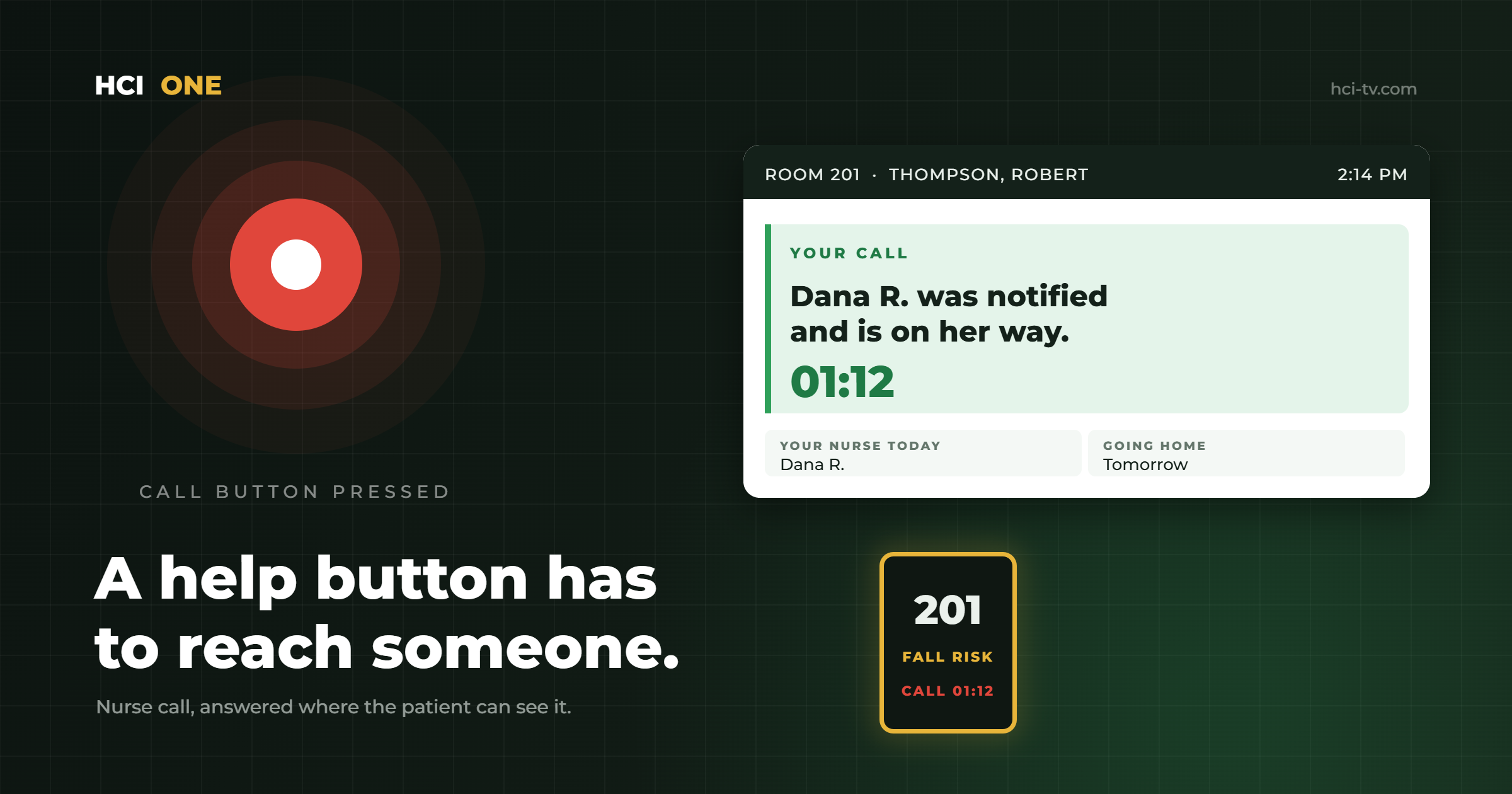
The patient sees the call was received, who has it, and how long it has been.
The door
Anyone in the hall sees the call and the precautions before walking in.
The unit board
Every open call in one place, each with a live timer. The longest wait stands out.
Call · 01:12
Fall risk
The phone
One nurse accepts and the call leaves everyone else’s queue.
Illustrations use sample data. No patient information is shown.
When the nurse call system clears the call, every screen clears with it. Nothing about the button changed. Nothing about the call changed. It just finally has somewhere to go.
What the patient actually sees
The board in front of the bed spends most of the day answering questions. During a call it has one job: tell the patient that a human being knows, and put a clock on it.
Sample data. The care team, schedule and discharge line come from the hospital’s own systems.
The old way, and the room that answers
The best call is the one nobody has to make
Answering faster is good. Not being needed is better. A lot of the calls I have watched get answered were not emergencies. They were questions. Who is my nurse. When is my test. When do I go home. A patient who can reach their own water doesn’t press a button for water. That is the whole feature.
Answer it first
Who is my nurse. When is my test. When do I go home. The board answers those before anyone reaches for the cord.
Round at the board
Pain, position, toileting, things in reach — captured with a badge tap, in the room, where the round actually happened.
See it coming
Live calls sit beside rounds due and overdue, so the charge nurse sees where attention is short before a patient has to ask.
Nothing on the wall gets replaced
Nurse call is expensive, it is regulated, and it works. Nobody is ripping that out because we showed up with a screen, and no nurse in the history of nursing has asked to learn a second system.
Back to Robert
He presses the button. The light comes on over his door, the same as it always has. This time the board across from his bed tells him Dana was told, puts her name on it, and starts counting.
He stops wondering. He stops pressing it again. That is the entire difference, and it is bigger than it sounds at two in the morning.
A room full of screens telling a patient everything about their care, sitting next to a button that goes nowhere, is not a smart room. It is a decorated one. A help button that doesn’t reach anybody undoes the rest of it in one press.
Nurse call is not an accessory to a patient room project. It is half of it. We build the other half around it, and we would rather show you than write about it.
See your call light the way the patient does.
We build the demo on the nurse call system you already run, with sample data, and walk one call through all five screens. About thirty minutes.
Every screen pictured here uses sample data.