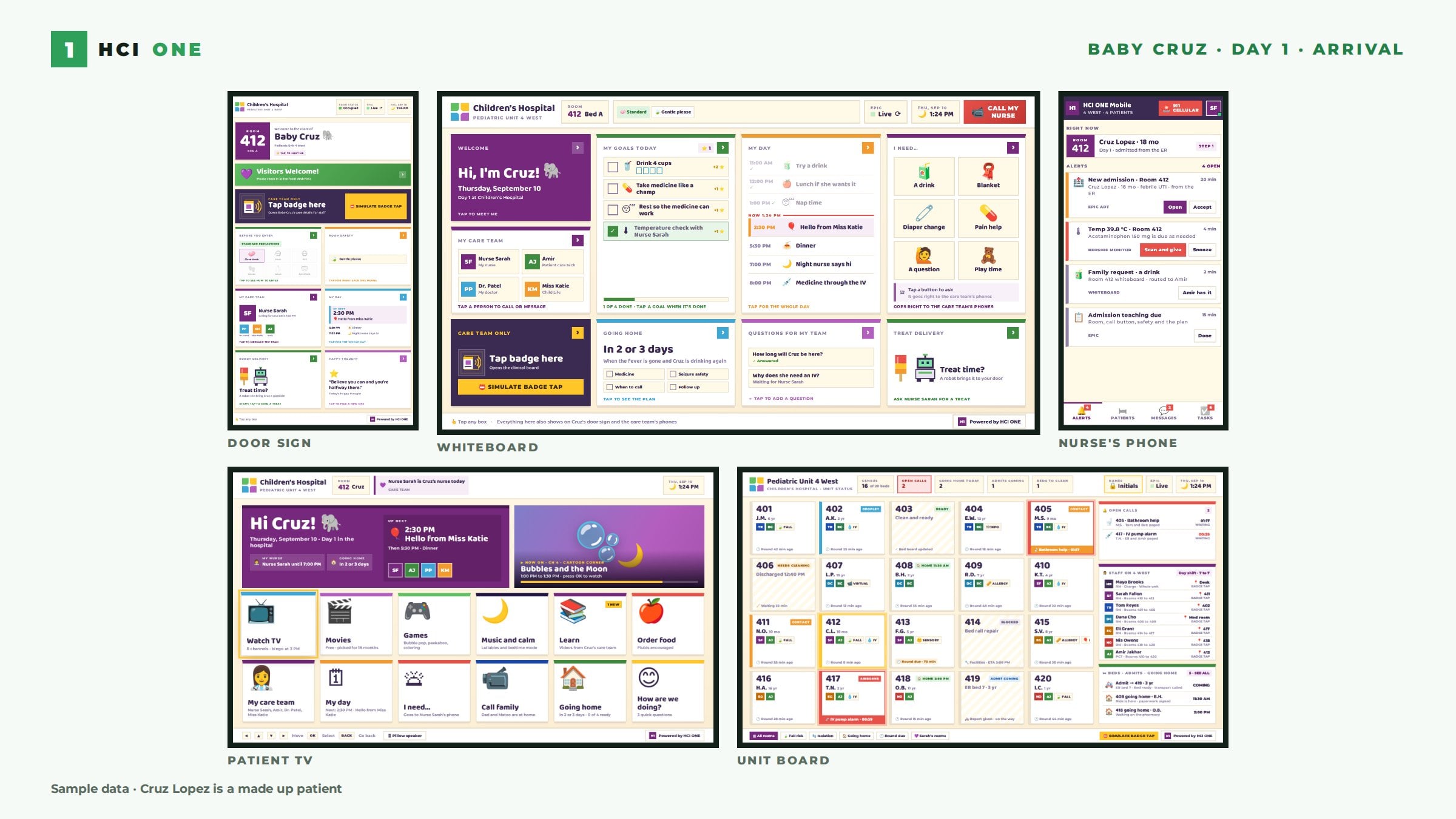
A children’s hospital room is not an adult room with a smaller font on it.
That sounds obvious. It is not how most of this industry builds.
You cannot put a spinal tap on a child’s whiteboard
Here is the clearest example we know.
On an adult whiteboard, today’s schedule is a feature. The patient wants to know what is coming and when. So the board lists it.
Put that same board in a pediatric room and it reads: Lumbar puncture — 2:00 PM.
A seven-year-old can read that. So can her eleven-year-old brother in the chair by the window. And the eight hours between breakfast and two o’clock stop being a day and start being a countdown.
So on a child’s board, the procedure is not there. It lives on the staff view, where the nurse and the physician need it, and where the parents can be walked through it by a person instead of by a wall. What the child sees is what she can win at — cups of juice, stars, when Mom comes back.
Same data. Same room. Same minute. Three audiences, and only one of them should be reading the word lumbar.
We think about that kind of thing because we care.
That decision is not a setting somebody toggles during implementation. It is designed in, and it is the reason a pediatric room needs a product built for pediatrics rather than a general one with the logo swapped.
Meet Cruz
The easiest way to show what that looks like is to stop describing screens and follow a patient.
Cruz Lopez is 18 months old. She weighs 10 kilograms. She lives with Mom, Dad and her big brother Mateo, and she does not go anywhere without Ellie, her stuffed elephant.
For three days she has had fevers up to 104.5 °F. She stopped eating. She barely drinks. Her pediatrician sends her to the ER, where a urine test finds a kidney infection. She is admitted to Room 412.
Cruz is made up. Everything about her is sample data. But every parent who has sat in that chair knows her.
Five screens, one story
A children’s room has three audiences. A child who may not read yet. Parents who read everything, twice. And a care team that needs the clinical picture in a glance.
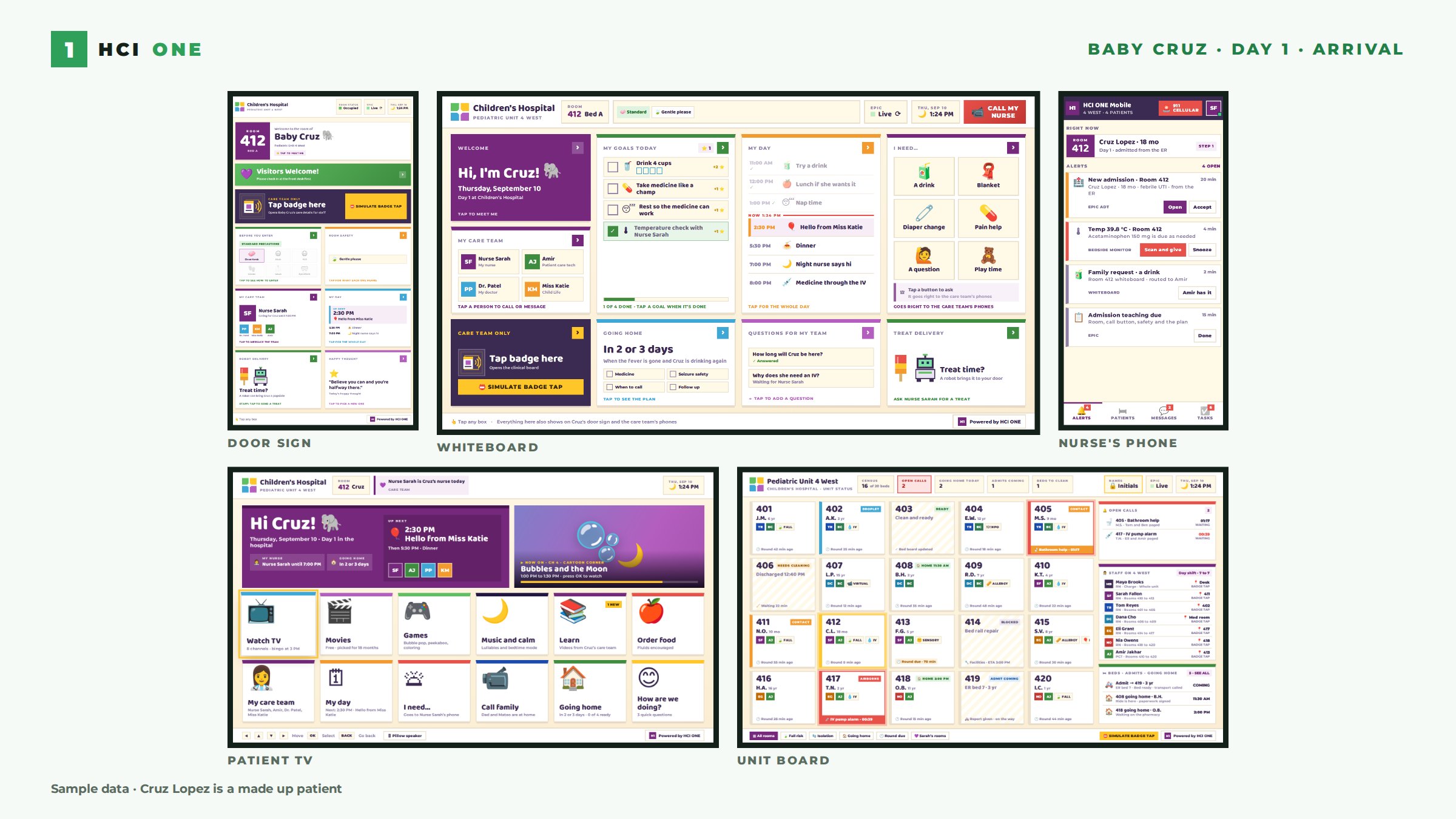
Five surfaces carry Cruz’s admission, and each one tells her story in its own words.
The door sign says hello to Cruz by first name and tells visitors what to know before they knock.
The whiteboard introduces Nurse Sarah, Dr. Patel and Miss Katie from Child Life. Her first goal is to drink four cups, and the board counts them with pictures.
The Patient TV says hi, picks movies for her age, and lets Mom order food that follows her diet order.
The unit board at the nurses’ station shows Room 412 as C.L., 18 months. Initials only. Full names take a badge tap.
Sarah’s phone gets the admit with Cruz’s weight and dosing zone already on it.
Nobody types any of that five times. It comes from the record, the nurse call system and a badge tap, and each screen shows what its audience needs to see.
Then the afternoon goes sideways
Day 2 starts well. The fever is coming down. Cruz still will not eat, so Sarah taps the door sign and sends a delivery robot for a popsicle. Cruz eats the whole thing, her first food in two days. The goal checks off on the whiteboard and she gets two stars.
That afternoon her fever spikes to 104.2 °F and she has a seizure that does not stop. Her lips turn blue. Mom presses the call button. Sarah calls a Code Blue from her phone.
This is the part of the design that matters most, because a code is where screens either help or get in the way.
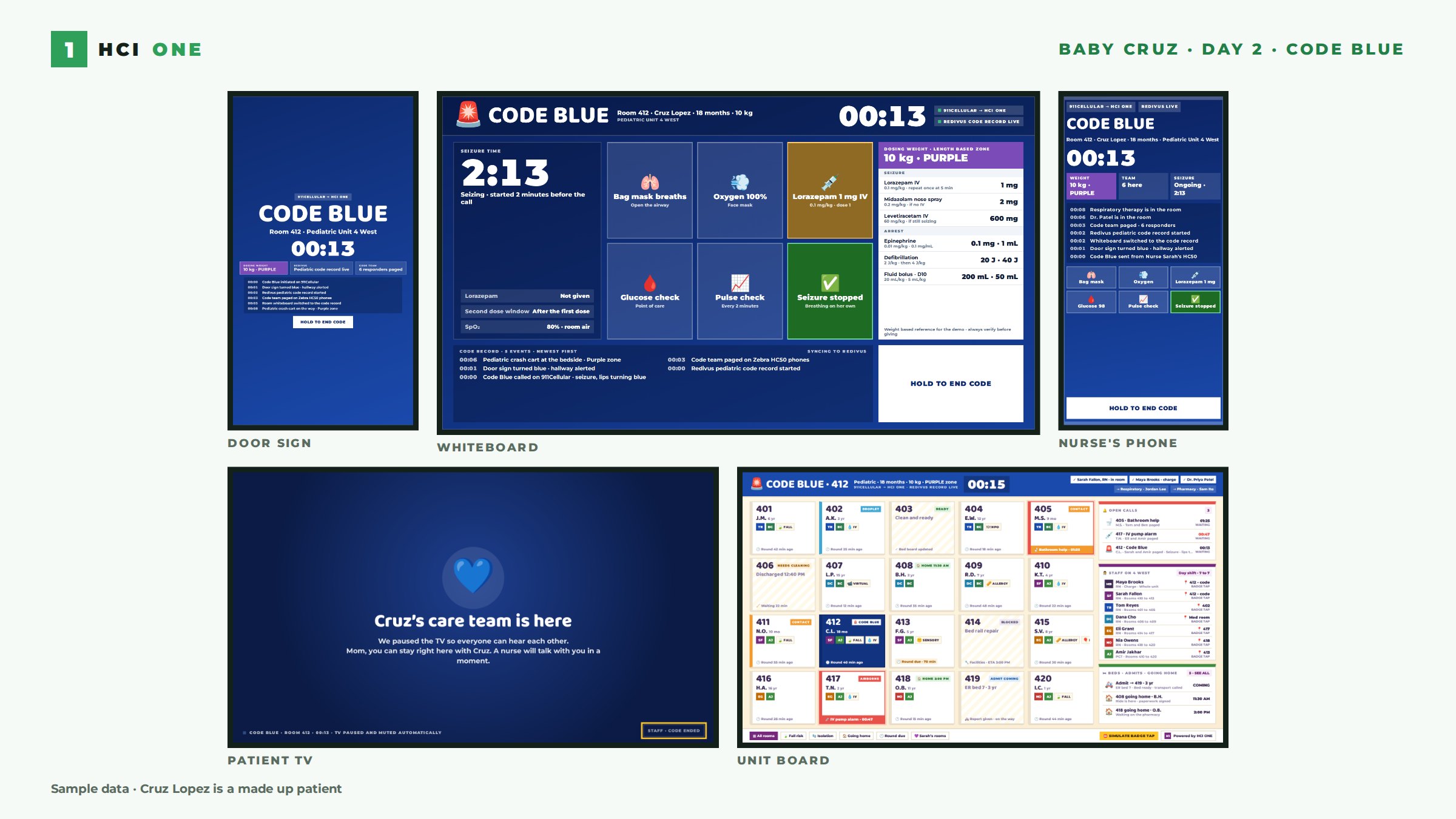
The door turns blue, so everyone in the hall knows where to go.
The whiteboard becomes the code record. Seizure timer, weight-based doses for a 10 kilogram child, every event logged.
The TV pauses the movie, mutes itself, and tells Mom the team is here.
The unit board turns into a code banner with a timer and who is responding.
The seizure stops at about six minutes. No CPR. Every screen adds seizure safety, and the TV switches to lullabies while Cruz sleeps it off with Mom.
Going home
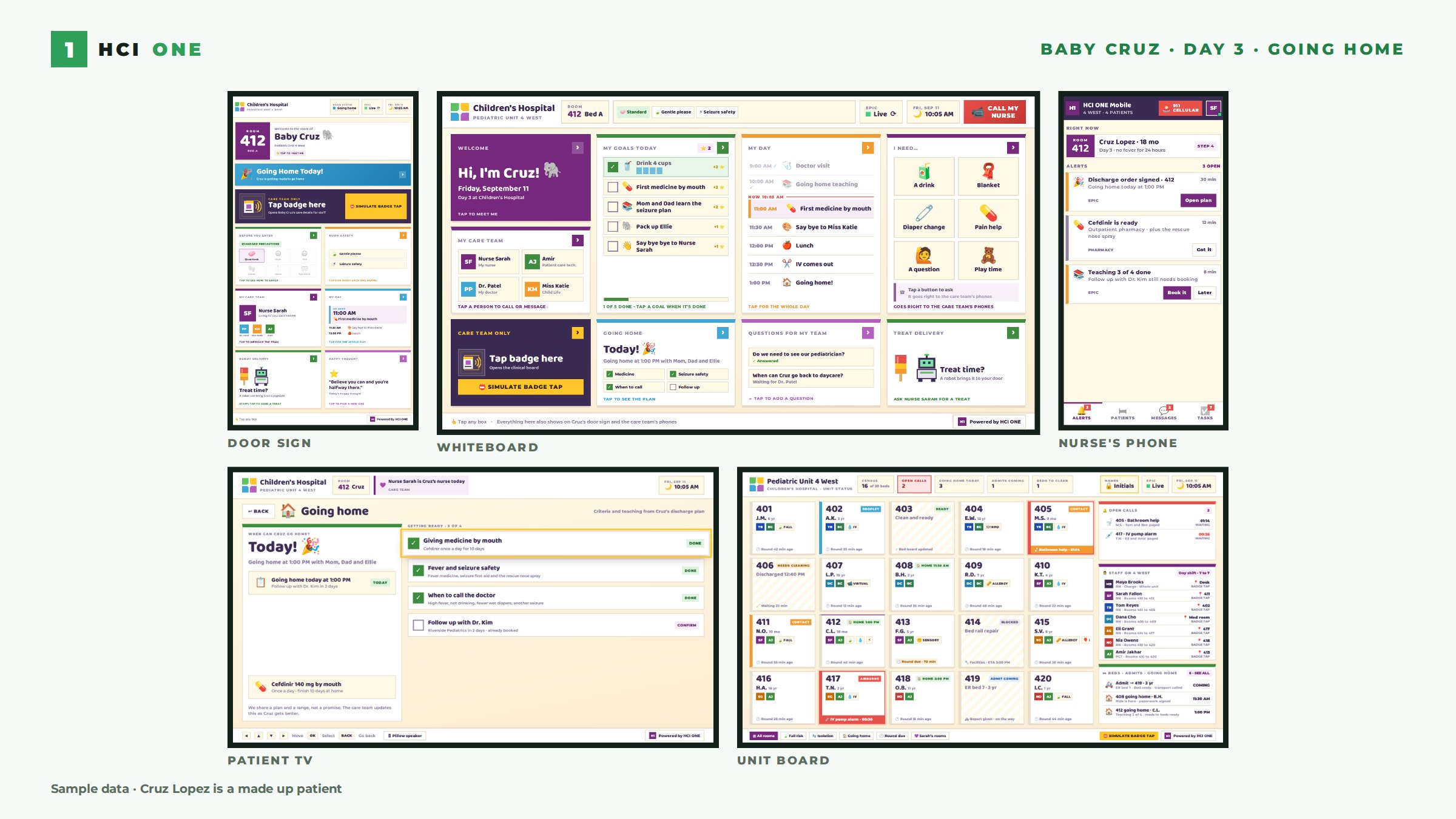
Day 3. No fever for 24 hours. She is drinking again. The door says Going Home Today.
Mom and Dad watch the videos Sarah assigned on the TV: the medicine, the seizure plan, when to call the doctor. When a video ends, the TV asks if it helped, and it counts toward Cruz’s teaching. If they have a question, it goes to Sarah and onto the whiteboard.
At 1:00 PM Cruz leaves holding Ellie. The discharge flips the door to Needs Cleaning, resets the TV so her name and history are gone, and puts 412 in the cleaning queue.
The most expensive movie subscription in history
Here is why this matters for children’s hospitals right now.
A lot of them bought the same bedside platform about ten years ago, and have paid for it per bed ever since. What that money bought is, mostly, a movie menu.
Now the renewals are coming up, and some of those same rooms are being offered laptops on brackets as a free upgrade.
A laptop on a bracket is not a door sign. And free hardware is never free.
Cruz does not need a better movie menu. She needs a room where the door, the board, the TV, the station and the nurse’s phone all know the same thing at the same time, and each one says it in a way its audience understands. Pictures for Cruz. Plain words for Mom. The clinical picture for Sarah.
That is not a bigger movie menu. That is a different kind of room.
What child-first actually means
These are design decisions, not configuration options. They are what a pediatric build has that a general one does not.
Pictures before words. An 18 month old cannot use a pain scale. Her board counts cups and stars. Pain is scored by her nurse, on the staff side.
The scary things live on the staff view. Procedures, orders, and anything a child should hear from a person rather than read off a wall.
Weight comes first. Every staff view carries her 10 kilogram dosing zone, so the doses on the code record are already worked out.
Privacy at every distance. First name on the door and the TV. Initials at the station. Full names after a badge tap.
Ranges, not promises. Going home in 2 or 3 days, when the fever is gone and she is drinking. Never a countdown.
None of that is a feature list. It is a set of decisions about who is in the room, made by people who have spent twenty-five years in patient rooms and have opinions about what belongs on the wall.
Give us one unit and a bed count, and we will build that unit’s version of Cruz on sample data, before anything is bought.
Ellie comes standard.
See the platform behind the writing.
Thirty minutes, real software. We connect HCI ONE to a sample chart and walk your scenarios.
Book a demo ← All posts