The Whiteboard Is Becoming a Virtual Nursing Endpoint
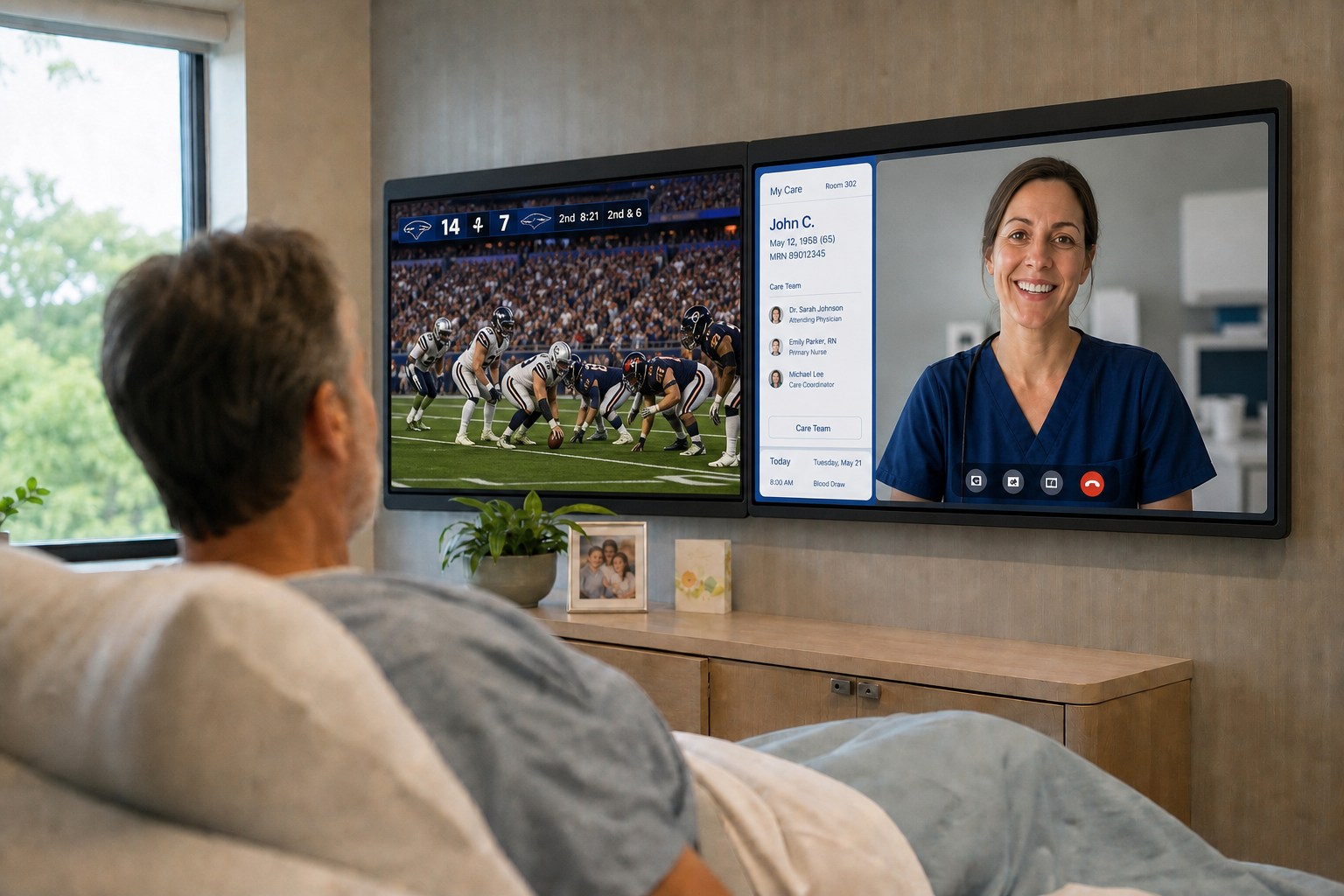
Let’s begin with the original patient room whiteboard.
The dry erase board.
It is usually in one of two conditions.
It is completely blank.
Or it contains information that started becoming outdated the moment someone wrote it down.
A nurse writes the care team, daily goal, pain plan, and expected discharge date. Then the nurse changes assignments. The physician changes the plan. The discharge date moves.
The marker information remains exactly where it was, confidently reporting yesterday’s news.
That is not because nurses are ignoring the whiteboard. It is because they have actual patients to care for.
The traditional whiteboard also requires three pieces of advanced medical technology:
A working marker.
An eraser.
Someone with readable handwriting.
Finding all three at the same time can be surprisingly difficult.
The digital whiteboard fixed the first problem
A digital whiteboard receives information from the hospital’s clinical systems.
When the care team, schedule, precautions, or discharge plan changes, the whiteboard changes.
It does not lose the marker. It does not become tired. It does not write the new nurse’s name in handwriting that looks like an electrocardiogram.
That was round one.
We have now deployed digital whiteboards across most of our customers. They keep patients informed, connect with hospital systems, and eliminate a manual task that nobody had time to do consistently.
Now we are going back for round two.
The whiteboard is becoming a virtual care endpoint
The whiteboard is already mounted in the patient room. It is already connected. The patient and family can already see it.
With HCI ONE Guardian, that same screen can become a virtual nursing endpoint.
A virtual nurse can appear directly on the whiteboard to support admissions, discharge preparation, education, medication review, rounding, translation, documentation, and family communication.
When the conversation ends, the screen returns to the patient’s care information.
No additional monitor.
No tablet sitting on a cart.
No new device that everyone notices during installation and nobody can find six months later.
Round two goes much further
We are now returning to many of these hospitals to add eSitting.
Soon, we expect the same platform to support medical grade transcription, virtual bedrails, and additional virtual care workflows.
That means the whiteboard can evolve from displaying information to actively supporting the care team.
It can connect a virtual nurse.
It can support patient observation.
It can help capture and structure clinical conversations.
It can become part of a broader safety strategy.
And it can do all of that through a screen the hospital already purchased and installed.
Healthcare has a habit of solving every new problem with another device. Every device has to be purchased, powered, secured, updated, cleaned, managed, and eventually replaced.
Someone also has to find the charger.
Our approach is different.
Use the endpoint already in the room. Keep the architecture open. Add new workflows as the hospital is ready for them.
The dry erase board was blank or becoming outdated.
The digital whiteboard made the information current.
Virtual nursing made it interactive.
Now eSitting, medical grade transcription, virtual bedrails, and more are making it part of the clinical care environment.
Same screen.
Same wall.
A much bigger job.
And nobody has to find a marker.
Part of the team building the operating system for the patient room.
Four Rooms Is Not a Program
New
The Door Sign Is an iPad Now
Walk down any med surg hallway and look at the doors. A paper card in a plastic sleeve. A precaution sign taped above it. A dome light over ...
We Built a Hospital Room in a Warehouse
Field notes
See the platform behind the writing.
Thirty minutes, real software. We connect HCI ONE to a sample chart and walk your scenarios.
Book a demo ← All posts