What a 400 Television Update Really Costs
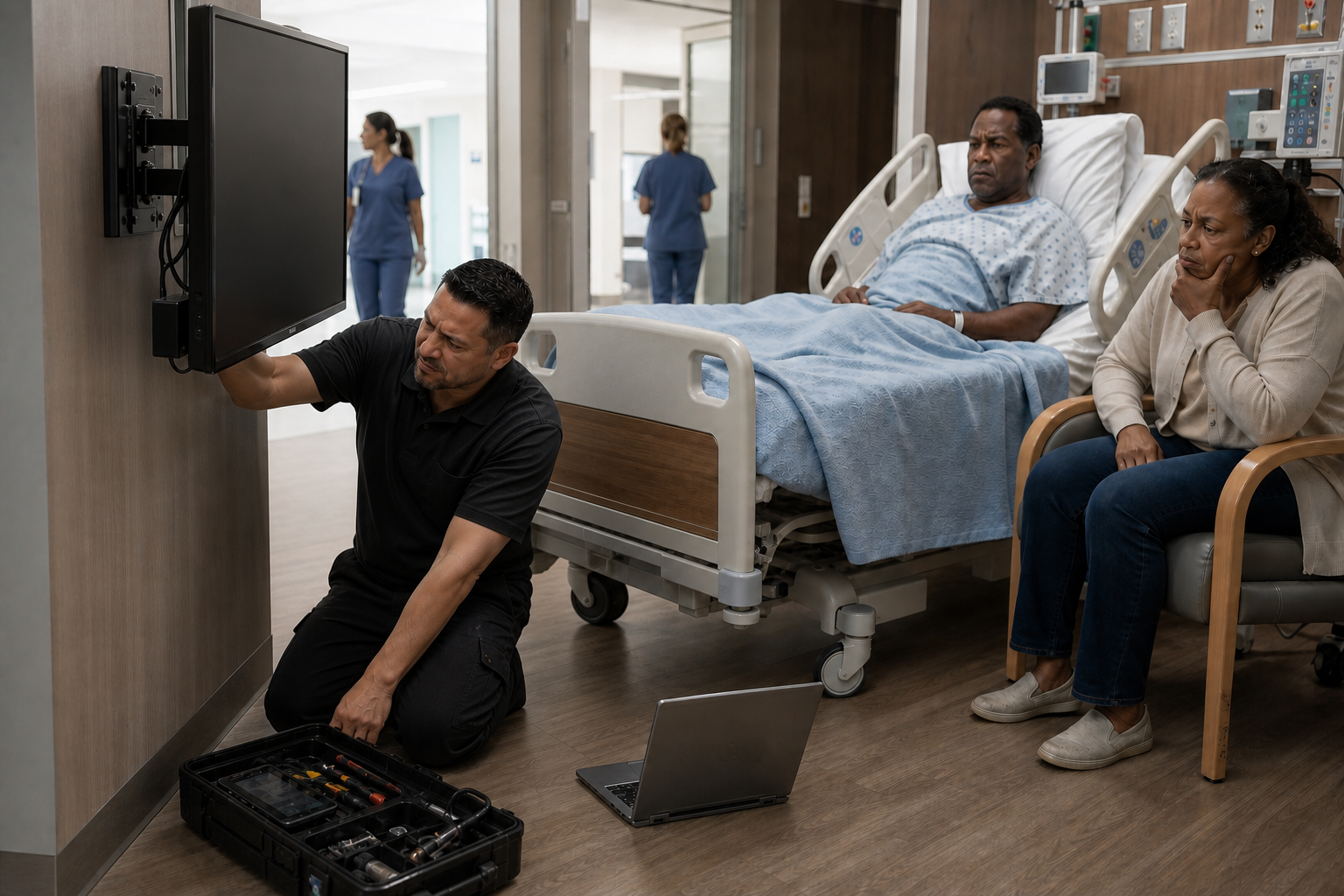
Think about your phone for a second.
How often do you close an application because it stops responding? How often do you restart the phone? Probably at least once a month.
How many software updates do you receive? How many applications update without you even noticing?
Now imagine managing four hundred phones that belong to other people, are spread across several buildings, and cannot be removed from the rooms.
That is a hospital television fleet.
One television is easy
Updating one television takes a few minutes.
Updating four hundred televisions can consume more than one hundred technician hours.
Someone has to identify every device, confirm the model, check the firmware, enter the room, perform the update, verify the result, and document what happened.
If the patient is sleeping, receiving care, or in isolation, the technician returns later.
If the television listed in room 412 is actually in room 418, everyone gets to enjoy a small mystery.
And all of this assumes the television is plugged in.
At least one device is always unplugged
I have visited a lot of customer sites over the past twenty years.
At least one device is physically unplugged every single time.
The support ticket says the device is offline.
Technically, that is correct.
It is extremely offline.
Sometimes the power cord is completely missing. Nobody knows where it went. The cord has simply left the hospital and begun a new life.
HCI ONE Engine can identify the device, location, and time it stopped communicating.
It cannot send electricity through an unplugged power cord.
AI cannot fix this either.
At least not yet.
I am sure someone is raising money for it.
Software cannot fix everything
We once found a television with a broken pencil pushed into the earphone jack.
I still have questions.
At another hospital, a bedside tablet was used as a crutch to help a patient get out of bed.
This was not an intended product feature.
The tablet did not perform particularly well in this role.
There is no software patch for a device being used as mobility equipment.
Engine cannot plug in a television, locate a missing power cord, remove a pencil, or stop someone from standing on a tablet.
What it can do is separate those problems from the work that should have been automated years ago.
Now imagine a fleet of iPads
Some hospitals use iPads for discharge education.
An iPad can make sense for a specific workflow. It can also become a fleet of problems.
Applications freeze. Operating systems update. Passwords expire. Batteries lose capacity. Charging cables disappear.
Now multiply that by dozens or hundreds of devices.
Every iPad must remain charged, connected, secure, clean, updated, and available.
The problem is not that iPads are bad devices.
The problem is that consumer devices require management, and small problems become large problems when multiplied across a hospital.
Engine handles what software can fix
HCI ONE Engine gives the hospital a live inventory of connected devices.
It identifies models, software versions, firmware, configurations, and status.
It can distribute updates remotely, manage applications and channel lineups, group devices, schedule changes, and verify the results.
Instead of entering four hundred rooms, the technology team updates the fleet centrally.
Then it focuses on the exceptions.
The unplugged television.
The missing power cord.
The moved device.
The tablet with seven percent battery life.
The television currently storing part of a pencil.
Engine does not eliminate every problem.
It identifies the few problems that require a person and automates the work that does not.
Engine pays for itself
This is not only about convenience.
It is about return on investment.
A single fleetwide update can consume more than one hundred technician hours.
Then add channel lineup changes, application updates, firmware updates, inventory work, repeat room visits, isolation procedures, and routine troubleshooting.
The labor adds up quickly.
Every hour spent walking from room to room with a remote control is an hour a skilled technology professional is not spending on networks, security, integrations, clinical systems, or another problem that requires actual judgment.
Engine replaces most of that manual work with centralized management.
The hospital still has to handle the unplugged television and the pencil in the earphone jack.
But it stops paying skilled people to enter hundreds of rooms for work that software can perform remotely.
When you count the technician time, avoided room entries, faster troubleshooting, and fewer missed devices, Engine pays for itself.
Then it keeps paying for itself with every update after that.
Walking is excellent for your health.
It is not an enterprise device management strategy.
Update the fleet remotely.
Then send someone to investigate the pencil.
Part of the team building the operating system for the patient room.
The Door Sign Is an iPad Now
Walk down any med surg hallway and look at the doors. A paper card in a plastic sleeve. A precaution sign taped above it. A dome light over ...
We Built a Hospital Room in a Warehouse
Field notes
A Help Button Has to Reach Someone
Nurse call
See the platform behind the writing.
Thirty minutes, real software. We connect HCI ONE to a sample chart and walk your scenarios.
Book a demo ← All posts